
 4 hours ago
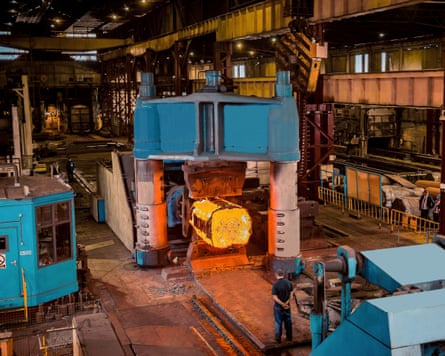
In its 160-year history, Somers Forge’s furnaces in the Black Country have cast steel columns for the Bank of England, part of the anchor for the Titanic and – more recently – propeller shafts for Britain’s nuclear submarines.
The economic fallout from the Iran conflict is the latest of many geopolitical headaches the family-owned forge has endured, but it is already “very damaging”, said Tammy Inglis, the Somers finance director.
Energy was about a fifth of manufacturing costs at the forge, which employs 140 people in Halesowen, before the conflict began, but that proportion is now rising. “Everybody just battens down the hatches and spends what they absolutely need to spend,” said Inglis. “You’re in survival mode.”
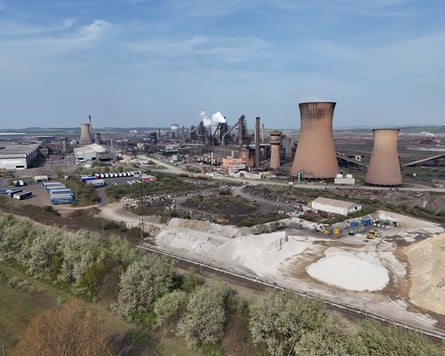
It is a predicament shared by energy-intensive companies across Britain and Europe. The Iran conflict has arrived as the latest – and for some potentially decisive – blow to industries such as steel and chemicals, already weakened by years of sky-high energy costs and cheap competition from abroad. At British Steel’s Scunthorpe plant, the operating costs of the plant taken into public control last year are already £1.3m a day.
The conflict has disrupted global supplies after Iran started attacking ships in the Gulf and choked off access through the strait of Hormuz, the narrow waterway that a fifth of the world’s oil and gas normally passes through.
British wholesale gas prices climbed as high as 171p a therm after the invasion began, their highest level since Russia’s full-scale invasion of Ukraine in 2022, and up from 78p a therm at the end of February. They hovered around 132p a therm at the start of this week.
The UK imports about 70% of its gas, leaving it vulnerable to price swings.
Inglis said Somers Forge’s monthly gas bill has soared from £150,000 to as high as £250,000 based on recent prices. “Unfortunately, at the moment, we are literally just having to take the prices as they come.”
Chemicals crisis deepens
The exposure is even worse for the chemicals sector, where companies rely on gas not just to power their plants but as feedstock – the raw material that many products are made from – meaning every spike in prices hits them twice.
The industry in Britain was already in crisis before the Iran war began, mainly blamed on high energy prices. Production output has fallen by 60% since 2021, according to the Chemicals Industry Association, with at least 25 sites closing since then.
Peter Huntsman, the boss of the global chemicals group Huntsman Corporation, bought much of the UK operations of Imperial Chemical Industries (ICI) – for decades Britain’s largest producer – in 1999.
A single Huntsman plant remains in the UK, at Wilton on Teesside, employing about 80 people. But the chief executive threw doubt on the site’s future if high prices persist into the summer.
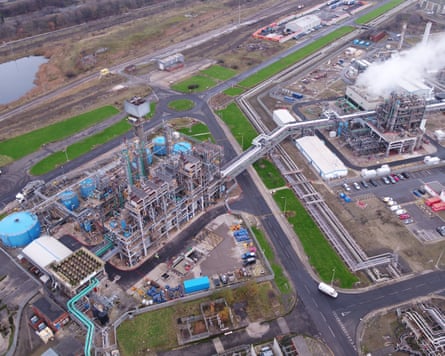
“If today’s economics were to stay in place for the next three months, I would shut down my [UK] facility and I’d be importing product from China or the US,” he said.
When the first missiles struck Iran, Huntsman imposed surcharges of 20%-30% on its European and UK customers to cover rising gas costs – but that was enough to make some of them look elsewhere.
“A lot of customers will just say: ‘I’m already hurting. I’m just going to shut down my operations … or I’m going to buy from the Chinese instead,’” Huntsman said.
Fellow chemicals magnate Jim Ratcliffe’s Ineos group will be on alert over the impact of the Middle East crisis, as his sprawling empire attempts to tackle a huge debt pile.
Ratcliffe received a £120m government bailout in December to save its ethylene cracker at Grangemouth, but Huntsman said not every company would receive such support if the crisis dragged on for a long time.
“If you’re an Ineos you’re probably going to get a government bailout. If you’re a small operation with a couple dozen employees, you’re not going to get a bailout,” he said.
“If you don’t have a balance sheet that can weather a storm for a couple of months – and most small companies don’t – yes, they go under.”
‘A broader structural issue’
The situation is just as uncertain across the Channel. The EU has also seen gas prices rocket, exposing the lack of sufficient rewards for energy intensive steel industries which are already switching to renewables, industry bodies have warned.
Adolfo Aiello, the deputy director general for climate and energy at Eurofer, the EU’s steel representative body, said the war “highlights a broader structural issue. Even when most electricity in Europe is generated from low-cost renewables, the final gas-fired plant often sets the price for everyone. As a result, geopolitical shocks still ripple straight through to Europe’s industrial electricity bills.”
The continent’s steel industry has for the past year been warning that it is in danger of collapsing unless something is done to change the way electricity is priced.
Energy costs are already among the highest in the world, far above those in the US and China with “additional spikes” due to the war “simply adding to an already fragile situation”, said Aiello.
Cargoes disrupted
Much of the focus around the crisis of tankers stuck either side of the strait of Hormuz has been on oil and gas shipments. But chemical cargoes in the region are also significant. Last week, shipments held up included 26 vessels carrying 1.5m tonnes of bauxite, limestone, sands and sulphur, 18 vessels carrying grain, mostly corn and 19 ships carrying 855 tonnes of fertiliser, mostly urea and phosphates.
In most immediate danger is Europe’s agriculture sector which sources 11% of its urea from the Gulf, and a further 26% of its urea from Egypt which is produced in factories fuelled by natural gas by pipeline from Israel.
“Egyptian urea has gone from $500 per tonne at the start of the war to more than $650. There is a direct impact on the price of fertiliser” for European farmers, said Argus Media consultant Arthur Portier.
The impact in China, India, Pakistan and Bangladesh seems to be more immediate with much larger dependencies on Iran and the Gulf for energy.
More than 50% of China’s crude oil comes from the Gulf compared with 12% in the EU, according to Chinese customs data and Eurostat.
BASF, the German chemicals group, said it was too early to judge the impact of the war but that its current supplies of chemicals were secure.
“Due to the current high volatility and the uncertain duration of the conflict, it is not yet possible to reliably assess the financial impact at this stage,” said a spokesperson.
Echoes of Ukraine
Back in the Black Country, with its 34 furnaces and vast 23-metre lathes, Somers Forge is among the last companies of its kind in Britain. It has supplied the Ministry of Defence for more than a century, making parts for submarines and military aircraft.
Inglis said she feared a lingering economic impact from the war. How long prices stay elevated depends on how quickly damaged energy infrastructure can be restored – a process analysts warn could take weeks or months even after the fighting stops.
While the company buys some of its energy in advance to lock in prices – a process known as hedging – it is still partly exposed to daily market swings to give it flexibility on how many shafts, valves and nozzles it produces.
“My broker contacted me and said we should buy some more energy … but then if you commit to a purchase for gas in 2027 at today’s prices, by the time we get there it could be half that price,” she said. “Then you’re not competitive in the market, because you’re using gas that’s twice the price that everybody else is.”
Somers is already seeing steel price rises throughout Europe and suppliers are only holding quotes for 24 hours, when they usually last a month. That makes it impossible, in turn, to quote customers without risking margins.
The situation echoes the Ukraine crisis when the forge was forced to let people go, she said. Gas prices remain well below the £8 a therm Somers Forge was paying at one point in 2022 but Inglis was worried about a return to those conditions.
“At that time we were losing money and we had to lay people off.,” she said. “It’s still early days but I think there’s a risk that we could get to that level.”