
 3 hours ago

I recently participated in a symposium of the Denver-based Institute for Science & Policy, during which I had a “fireside chat” with Tony Mills of the American Enterprise Institute. Mills has written extensively on the politicization of science, and the two of us had a very enjoyable hour-long conversation on the topic. You can watch it below.
The main questions we dealt with are why there is such a vast partisan gap in trust of science, and to what extent this is a unique moment. Mills helpfully brings a good deal of data to the discussion, as he did in this useful piece at Issues in Science & Technology.
Note this graph, drawing on a range of survey data to demonstrate partisan attitudes toward science since 1970s. As it demonstrates, there’s been a very sharp partisan divergence in confidence in science during the Trump Era, starting prior to the Covid pandemic. At least in part, we can attribute this to a rise in populist anti-science rhetoric embraced by Trump, his appointees, and those in his media orbit.
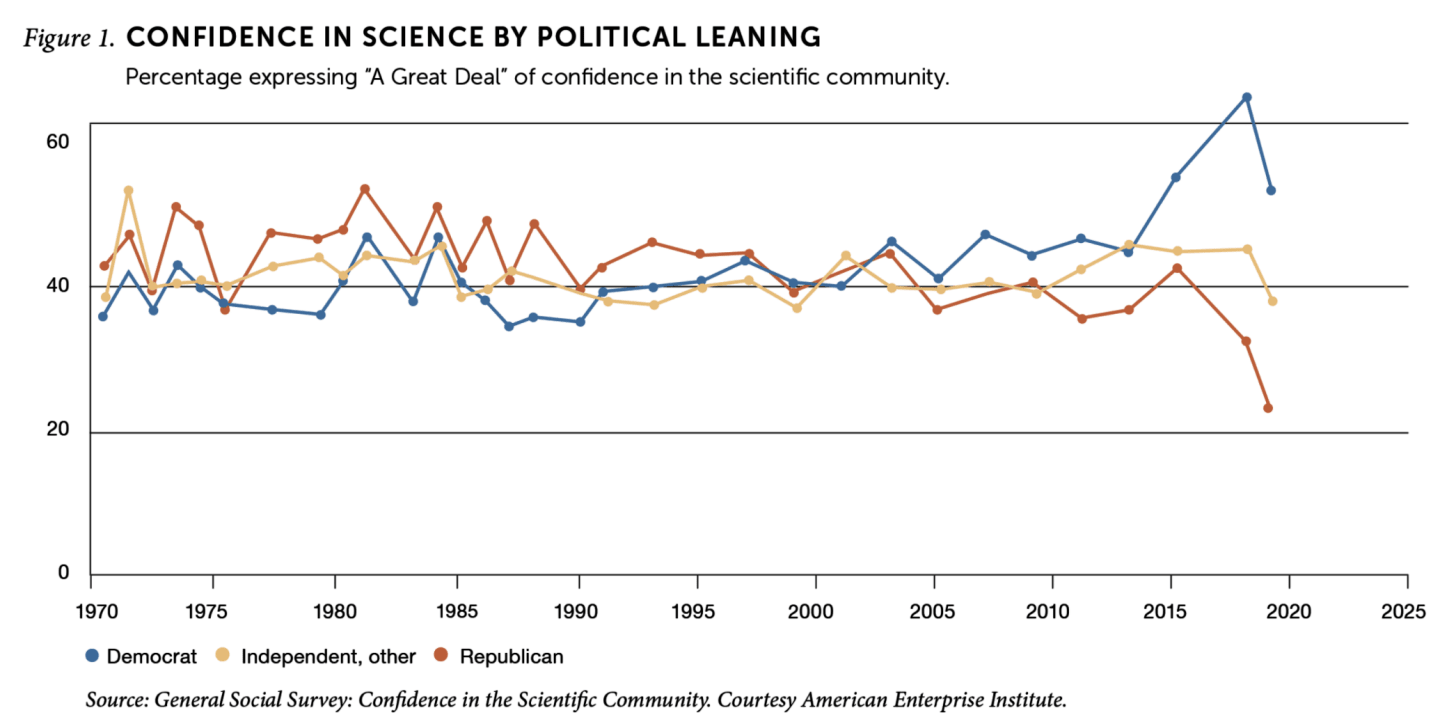
But as the graph also shows, the partisan divide has existed in the past, and it’s not always in the same direction. The largest divergence in party views toward science prior to 2016 was in the 1970s, when liberals equated scientific achievement with the military-industrial complex and thus trusted it less.
That era of scientific mistrust is often overlooked. Indeed, as Mills notes, the Moon landings (1969-72), which today are considered one of the last great moments of national unity, were experienced nothing like that at the time. There was sharp debate back then over whether the Apollo missions were worth the vast expenditures when the country had so much else to deal with.
It’s outside the dataset, and we don’t have the partisanship lens for it, but the 1950s was another deeply anti-science decade, with critics of intellectuals and college professors alleging their ties to communism and their lack of commitment to basic American moral beliefs. This was the subject of Richard Hofstadter’s 1962 book Anti-Intellectualism in American Life, in which he quotes religious leaders like Franklin Graham:
[In place of the Bible] we substituted reason, rationalism, mind culture, science worship, the working power of government, Freudianism, naturalism, humanism, behaviorism, positivism, materialism, and idealism. [This is the work of] so-called intellectuals. Thousands of these “intellectuals” have publicly stated that morality is relative—that there is no norm or absolute standard.…
This fervor was heavily whipped up by Sen. Joe McCarthy (R-Wisconsin), although it’s clear that not all his fellow Republicans were on board with his red-baiting.
What ended that era? The simple answer is the 1957 launch of Sputnik. Americans became afraid that they were losing to Soviet scientists, and suddenly university researchers and government projects were awash with funding.
In our conversation, I asked Mills about the possibility of us having a Sputnik moment again that would rally the American public in favor of science today. Mills argued that the COVID-19 pandemic was essentially a Sputnik moment — a terrifying threat to all Americans that required scientific advances to address. But thanks in part to political polarization and the populist and conspiratorial leanings of Donald Trump, we got the opposite of a unifying moment. Many Americans turned against science, despite science actually stepping up in that moment.
As we discussed in the chat, it’s not clear what scientists could or should be doing in this moment to increase faith in their work. As Mills notes, one of the chief complaints against scientists and professors is that they’ve become too political; scholars becoming even more political might not help them achieve their goals. This (mainly Republican-driven) anti-science era will end, of course, but it’s not clear what event will bring that about.
Share