
 7 months ago
Officers restrained a 10-year-old boy with autism face-down at school drop-off, placing a knee on the boy’s neck and fracturing his arm.
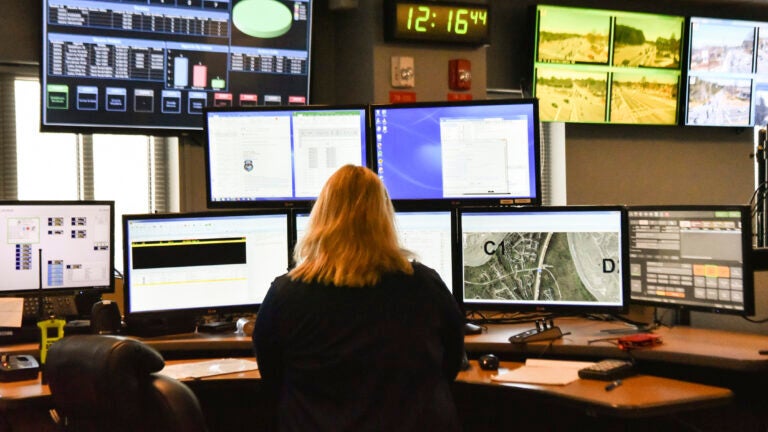 In this March 15, 2018 file photo, a dispatcher works at a desk station with a variety of screens used by those who take 911 emergency calls in Roswell, Ga. AP Photo/Lisa Marie Pane, File
Send this article to your social connections.
Advocates filed a federal lawsuit Monday, alleging that Worcester’s 911 service sends armed police officers to all mental health calls, discriminating against people with mental health disabilities or in crises by not providing adequate care.
Representing multiple advocates, the Center for Public Representation, or CPR, filed a federal lawsuit alleging that Worcester’s 911 program sent armed police officers to 100 percent of the thousands of welfare check calls the department receives each year.
“When Worcester residents experience a mental health emergency, such as suicidal ideation or post-traumatic stress episodes, the City’s default response to a 911 call is to send armed police officers who are not qualified to perform the core functions of an emergency mental health response,” the complaint said. “Armed police, by their presence alone, can escalate individuals in a mental health crisis.”
In the lawsuit, advocates pointed to multiple situations that escalated to violence. In 2025, a 14-year-old boy with mental health disabilities and autism was physically restrained for several minutes and handcuffed, the lawsuit alleges. Worcester officers also restrained a 10-year-old boy with autism face-down at school drop-off, placing a knee on the boy’s neck and fracturing his arm, the plaintiffs claim.
The National Alliance on Mental Illness of Central Massachusetts, its statewide chapter, and the Parent Professional Advocacy League are the plaintiffs, represented by CPR and the Disability Law Center.
The City of Worcester, the sole named defendant, did not return a request for comment Wednesday evening.
When 911 receives physical health calls, like for a heart attack, dispatchers send health responders like EMTs or paramedics, the lawsuit says, while a mental health emergency prompts a default response of sending armed police officers. The contrast violates federal anti-discrimination law, the DLC said.
“There are trained professional first responders for fire. Trained professional first responders for crime. Trained professional first responders for medical emergencies. Where are the trained professional first responders for mental health? There are none,” said Pam Sager, the executive director of PPAL, in a press release. “Our children and youth deserve equal treatment.”
The lawsuit included examples of a woman living at a shelter who was refusing to eat, talk, or leave her living space. Staff called 911 asking for mental health assistance, and the officers who arrived were unable to help.
A Worcester woman, who was a former member of the Massachusetts National Guard, claimed in the lawsuit she felt “humiliated and traumatized when she perceived that the responding officers were mocking her, not taking her seriously, or considered her a nuisance.”
Less than 25% of Worcester police completed crisis intervention training
Advocates also pointed to the Department of Justice’s 2024 report that found that the Worcester Police Department committed multiple civil rights violations, including sexually assaulting women and escalating minor incidents with force. The lawsuit pointed to an officer punching a man experiencing a mental health emergency twice in the face.
The lawsuit says that Worcester began a pilot Mental Health Crisis Response Team in 2023, which “operated for limited hours each day.” It disbanded less than 19 months later and, since then, there have been “no equivalent professional clinical response to mental health emergencies,” the complaint alleges.
Fewer than 100 Worcester police officers, or less than a quarter of the force, have participated in a voluntary crisis intervention training program sponsored by the Massachusetts Department of Mental Health, the lawsuit said.
“Even for police officers who elect to participate in crisis intervention training, there are no standardized protocols or any targeted dispatch of these officers to mental health emergencies by Worcester’s Emergency Communications,” the complaint said.
“The current system leaves people in Worcester feeling that there is no available help for individuals experiencing mental health emergencies,” Robin Bahr Casey, the president of NAMI Central Mass.’s board of directors, said in the release. “We have hope that this lawsuit will bring about positive change.”

Molly Farrar is a general assignment reporter for Boston.com, focusing on education, politics, crime, and more.
Sign up for the Today newsletter
Get everything you need to know to start your day, delivered right to your inbox every morning.